
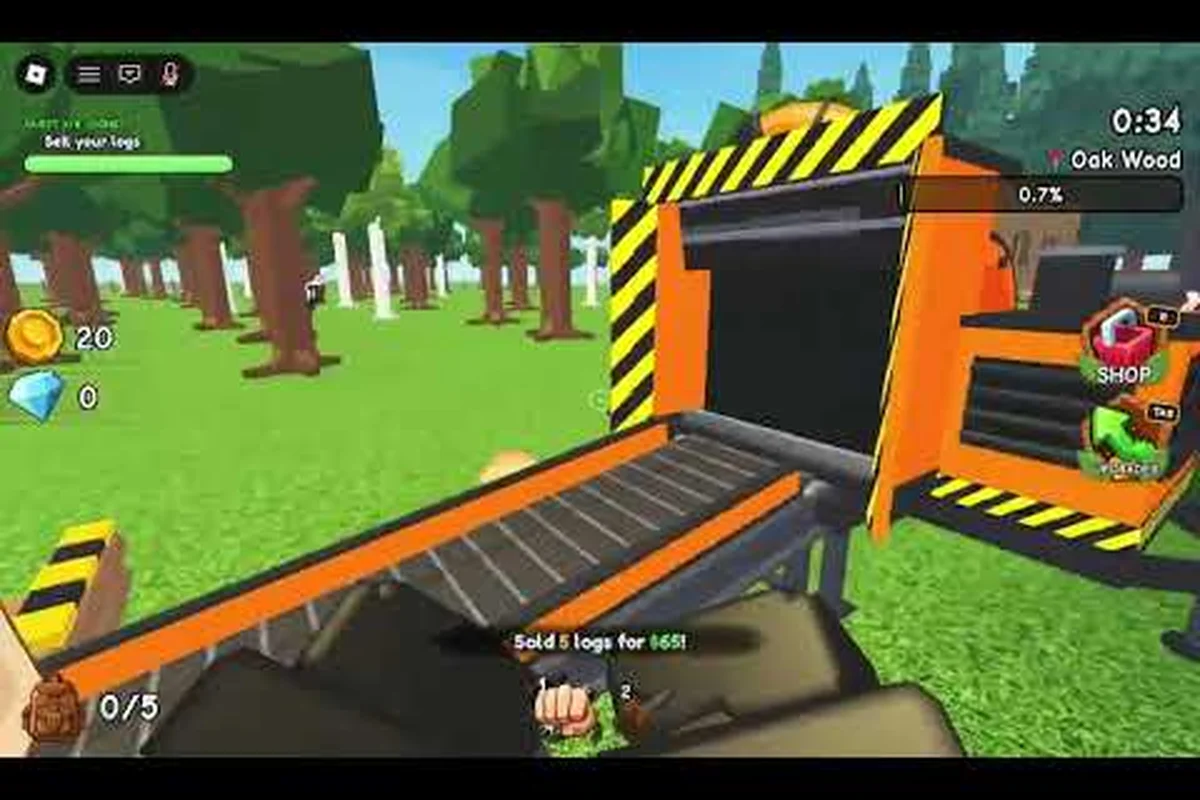
Every Chop A Forest run starts the same way: bare hands, a single tree, and a sawmill that won't stop humming. The problem is that most players keep making the same expensive errors from their first swing all the way to the late-game grind. This guide breaks down the Chop A Forest common mistakes that quietly drain thousands of Coins and waste hours of progress, so you can skip the painful trial-and-error and get straight to a clean 100 percent completion.
The biggest payoffs come from learning what NOT to do, and that is exactly what we cover below. From punching trees after buying the Axe, to skipping the offline Rewards tab, to burning Gems on a flashy class instead of a steady earner, every section ties a real in-game cost to the fix. If you are aiming for a smooth Chop A Forest endgame guide run, these corrections will save you real time and real currency.
Why Most Players Bleed Coins Early in Chop A Forest
The core Chop A Forest beginner mistakes almost always start in the first ten minutes of a fresh save. You spawn in front of the sawmill, punch a tree to break it into logs, and hold E to pick up to a few logs at once before carrying them to the sawmill for Coins. That loop works, but the moment you spend wrong, you set a bad tempo that lasts the whole session.
The first 500 Coins matter more than any late-game investment. Every early purchase is a multiplier on how fast you can return to the sawmill with full hands, which directly controls your per-minute income. Spend on the wrong upgrade and you are stuck at 60–80 Coins per trip for an extra hour. Spend correctly and you double that within twenty minutes. The gap compounds the entire run, which is why the Chop A Forest late game guide community keeps repeating the same handful of early-game rules.
The Tool and Stat Trap
Players see the Axe listed for 150 Coins and assume it is the answer to everything. The Axe does boost cutting power per swing, but it is not the only thing you should buy, and buying it before certain stat upgrades is a classic Chop A Forest common mistakes entry. A more efficient opening path looks like this:
| Priority | Purchase | Approx. Cost | Why It Matters |
|---|---|---|---|
| 1 | First Grasp level | ~100 Coins | Lets you carry more logs per trip, the single biggest income multiplier |
| 2 | First Walk Speed level | ~120 Coins | Cuts travel time between trees and the sawmill |
| 3 | Basic Axe | 150 Coins | Only relevant after Grasp and Speed, since damage without carry is wasted |
| 4 | Radius upgrade | ~200 Coins | Hits more logs per swing, but useless if you still carry only 2 logs at a time |
If you flip that order and buy the Axe first, you will hit trees faster but still walk back with a near-empty inventory. Community testing on the the Roblox listing for Chop A Forest shows that the first Grasp level outperforms the first Axe purchase in pure Coins-per-hour for the opening 30 minutes of a save.
Mistaking Activity for Progress
Another early error is treating the game as a clicker. You stand near one tree, mash the swing button, and hope the numbers go up. In practice, the best Chop A Forest beginner mistakes fix is to plan a tight circuit: chop tree, stack logs, walk to sawmill, sell, return, repeat. Skipping that loop and just sitting next to a tree means you lose the sawmill's bonus range, and you miss the small Coin bursts that come from clearing multiple trees in a row.
The same logic applies to the Tab menu. After the Axe, open Tab and spend Coins on grasp, walk speed, and radius before chasing any flashy Perk. The Perk shop looks tempting because it offers visible effects, but perks scale with your underlying stats. Boosting a weak base with a mid perk just produces a slightly less weak base. A solid Chop A Forest beginner guide reinforces this same priority order, because the economy is built around carry capacity first, speed second, and raw damage third.
Tool Upgrades That Look Good but Ruin Your Economy
The next layer of Chop A Forest common mistakes lives in the tool and perk tree. Once you have Grasp, Speed, and the Axe sorted, the game opens up tier-two options, and this is where a lot of runs go sideways. Tools and perks are designed to be incremental, not transformative, so chasing the next visual tier too early is one of the most expensive Chop A Forest beginner mistakes in the entire progression curve.
The honest truth is that most tier-two upgrades are roughly 10–20 percent better than tier-one at the same stat slot. The gap is real, but it is not worth skipping a perk that doubles your reach. Players who sprint for the next Axe skin and ignore the second Grasp level often find themselves earning less per minute at 2,000 Coins than they did at 800 Coins, simply because every trip still maxes out too soon.
Perk Priority vs Cosmetic Upgrades
The perk system mixes genuine income boosts with cosmetic or flavor perks. A clean Chop A Forest endgame guide run treats perks as a strict shopping list, not a browsing menu. The priority order looks roughly like this:
| Tier | Perk Type | Effect | Recommended Timing |
|---|---|---|---|
| Early | Carry / Grasp perks | More logs per trip | First 1,000 Coins of perk budget |
| Early | Speed perks | Faster sawmill runs | Right after Grasp perks |
| Mid | Radius / AoE perks | More logs per swing | Around 3,000–5,000 Coins |
| Mid | Auto-collect perks | Less manual hauling | Once radius is solid |
| Late | Aura / passive Coin perks | Background income | 10,000+ Coins, after tools |
| Skip | Cosmetic perks | No stat effect | Save Gems, not Coins |
Spending 600 Coins on a cosmetic perk that does nothing for income is the kind of choice that pushes a 100 percent run from smooth to painful. This is also where a structured Chop A Forest tips and tricks breakdown helps, because the visible perks are not the same as the useful ones, and the difference is hundreds of lost Coins per hour.
The Radius Trap
Radius is one of the most misunderstood stats in the game. A larger radius feels powerful because you see more logs fly off each swing, but if your carry capacity is still capped at a few logs, the extra logs just sit on the ground waiting. Until you push Grasp to its third or fourth level, extra radius is mostly wasted damage. The Chop A Forest 100 percent guide community calls this "chopping air" because that is literally what the surplus swings are doing.
The fix is simple: always check your current Grasp level before buying a radius upgrade. If your Grasp is below tier 3, save the Coins. A quick way to remember the ratio is to aim for at least one Grasp tier per radius tier, so a radius 3 upgrade only makes sense once Grasp is also at 3 or higher. This rule alone prevents one of the most common Chop A Forest common mistakes that players repeat across multiple saves.
The 6-Hour Rewards Stall Almost Everyone Skips
One of the most damaging Chop A Forest common mistakes is ignoring the offline Rewards tab. The game lets you log out, and when you return, a Rewards window tallies what your setup would have earned while you were away. The catch is that the tab is capped at roughly six hours of offline accumulation, after which it stops ticking. Players who log out for a full night of sleep and then only check the tab once lose the overnight roll entirely.
This is not a minor optimization. The Rewards window is essentially free Coins, and skipping it is the same as deleting a chunk of your wallet every day. The Chop A Forest late game guide tier of players treats the Rewards tab as a scheduled event, not a passive afterthought.
How the Rewards Window Actually Works
When you close the game or stay idle past the threshold, the server tracks your last-active state. On return, a popup appears showing the accumulated Coins and a small Gem bonus. The exact amount scales with your current Grasp, Speed, Radius, and equipped perks, which is another reason why investing in those stats early pays off twice: once during active play, and again every time you collect the offline tab.
| Offline Duration | Reward Behavior | Best Action |
|---|---|---|
| 0–6 hours | Full accumulation, capped at 6h | Log in and collect immediately |
| 6–10 hours | Same cap applies, surplus wasted | Split long breaks into two sessions |
| 10+ hours | Still capped at 6h, no bonus | Plan active play before sleep, idle after |
| Server reset | Tab may reset to zero | Always check the tab before a private-server reboot |
Community reports suggest the cap was added to keep the economy stable in long-running servers, but the practical effect is that any extra idle time beyond six hours is pure waste. The fix is to time your sessions: play actively for a stretch, idle, return to collect, then start another active window.
Timing the Stall Around the 100 Percent Push
For players chasing a Chop A Forest 100 percent guide completion, the Rewards stall is even more important because the final stretch of unlocks and class trials often requires tens of thousands of Coins in a tight window. Players who forget the Rewards tab for two days usually end up grinding an extra hour just to recover what the system would have given them for free.
A simple habit is to set a soft alarm for six hours after your last collection. If you plan to sleep for eight hours, log in once mid-sleep is unrealistic, so instead, plan a short pre-sleep active session, collect the tab, and start a fresh six-hour idle right before bed. That pattern alone closes a major leak in your economy and is one of the cleanest Chop A Forest common mistakes to fix.
Wasting Gems on Flashy Class Picks
Gems are the secondary currency in Chop A Forest, and they are the only resource you should never spend on impulse. Early Gems come slowly, mostly from Rewards windows, daily streaks, and rare drops, which means every Gem purchase has a long opportunity cost. The most expensive Chop A Forest common mistakes is burning Gems on a class that looks impressive but does not match your current income curve.
Classes are not purely cosmetic. They change your base stats, passive income, and in some cases your sell multiplier at the sawmill. The "best" class depends entirely on whether you are farming, speedrunning, or pushing the 100 percent milestones, which is exactly why class guides are a separate category on most Chop A Forest tier lists.
Matching Class to Stage of Progression
The Chop A Forest best early class breakdown is the cleanest reference for this section, and it lines up with how the economy actually behaves. Early on, you want a class that boosts carry and base Coins per log, because raw volume is the bottleneck. Late game, after tools and perks are maxed, the bottleneck shifts to sell multiplier and Aura passives, so a different class pulls ahead.
| Stage | Best Stat Focus | Wrong Gem Spend Example | Better Pick |
|---|---|---|---|
| First 5,000 Coins | Carry, base log value | Class with big AoE but tiny Grasp | High Grasp, modest AoE |
| Mid 5,000–20,000 | Speed, mid-tier AoE | Class locked behind Gems you do not have yet | Cheap class with Speed passive |
| Late 20,000+ | Sell multiplier, Aura | Pure cosmetic class with no stat passives | Class with passive Coin aura |
| 100 percent push | Balanced stats | Re-rolling for a duplicate class you already own | Saving Gems for the next tier unlock |
Notice how every "wrong" choice is the kind of thing a flashy icon in the class menu would tempt you into. The honest version of a Chop A Forest endgame guide is boring on purpose: pick the class that matches your current bottleneck, not the one that looks best in a screenshot.
The Duplicate-Class Trap
Once you start collecting classes, the game occasionally offers you a class you already own. New players often spend Gems anyway because the offer feels rare, but duplicates usually convert into a small refund or a minor token. The Chop A Forest late game guide consensus is to skip duplicate offers unless the refund is generous. Holding Gems for the next tier unlock is almost always more valuable, especially in a 100 percent run where every unlock matters.
If you are unsure whether a class is worth the Gems, check three things: does it raise your weakest stat, does it stack with your current perks, and does it improve your offline Rewards return. If the answer to two of those three is no, the class can wait. This single rule is one of the highest-impact Chop A Forest common mistakes to fix, because Gems are the slowest currency in the game and the easiest to waste.
The Optimal Play Loop for a 100 Percent Run
Once you have the early-game, mid-game, and Rewards habits locked in, the final piece is the late-game loop. A 100 percent Chop A Forest run is not about grinding one perfect strategy. It is about chaining three loops in the right order: a fast income loop, a steady upgrade loop, and a patience loop for offline accumulation. The Chop A Forest 100 percent guide path looks roughly like this in practice:
| Phase | Duration | Main Action | Common Mistake to Avoid |
|---|---|---|---|
| 1. Income ramp | First 1–2 hours | Push Grasp, Speed, Radius in that order | Buying the Axe before Grasp |
| 2. Perk consolidation | 2,000–10,000 Coins | Lock in carry and speed perks, skip cosmetics | Buying radius before Grasp 3 |
| 3. Class pivot | At ~5,000 Coins saved | Switch to a class that matches your bottleneck | Burning Gems on a duplicate class |
| 4. Rewards cycle | Every 6 hours | Log in, collect the tab, log out again | Letting the cap expire |
| 5. Endgame tools | 10,000+ Coins | Upgrade tools only after perks are maxed | Rushing the next Axe skin |
| 6. 100 percent cleanup | Final stretch | Clear all class, perk, and tool milestones | Re-buying perks you already own |
This loop is also the reason the deeper Chop A Forest all mechanics explained breakdown pairs naturally with a 100 percent checklist. The mechanics and the milestones are the same thing, viewed from two different angles, and skipping either side leads to the same end: a stalled save with 95 percent completion and no clear path to the last 5 percent.
The cleanest way to think about the endgame is in terms of waste, not effort. Every minute you spend on a wasted swing, a wasted Radius upgrade, or a wasted Gem is a minute the 100 percent run does not move forward. The Chop A Forest common mistakes we covered here are not dramatic failures. They are small leaks, and the difference between a smooth 100 percent run and a frustrating one is mostly about plugging those leaks early.
Frequently Asked Questions
What are the most expensive Chop A Forest common mistakes new players make?
The most expensive beginner mistakes are buying the Axe before Grasp, spending Coins on radius while carry is still capped, and burning Gems on a class that does not match your current stat bottlenecks. Each one costs several hours of lost income and is easy to avoid with a simple priority order: Grasp first, Speed second, Radius third, perks fourth, classes last.
How do I use the offline Rewards tab without losing the 6-hour cap?
Plan your sessions in 6-hour windows. Play actively, then log out, then return within six hours to collect the tab before it stops accumulating. If you need to be away longer, split the break into two shorter windows so the cap resets and ticks twice instead of stalling once.
Is there a reliable Chop A Forest late game guide for the 100 percent push?
A reliable late-game approach focuses on three loops: a fast income loop with maxed Grasp and Speed, a steady upgrade loop that prioritizes perks over tools, and a patience loop that collects the Rewards tab every six hours. Pairing those three loops with a class that matches your current bottleneck covers most of the 100 percent path without extra grinding.
Should I save Gems for late-game classes or spend them early?
Save them. Early classes offer small stat boosts that you can match with cheap Coin upgrades, while late-game classes meaningfully change sell multipliers and Aura passives. The Gems you spend on an early flashy class are Gems you will not have when the late-game options actually matter, which is one of the cleanest Chop A Forest common mistakes to avoid.
Do perks or tools matter more for the Chop A Forest 100 percent guide run?
Perks matter more, because perks scale with every other stat and apply during offline Rewards accumulation. Tools raise your active damage but stop contributing the moment you log out, so maxing perks first gives you a larger return across both active play and the 6-hour offline window, which is the backbone of a clean 100 percent run.